BMW 3 Series F30 / F31 / F34 · 4 Series F32 / F33 / F36 · 2013-2020 · Witson YB1292
Your F30 Still Has Analogue Dials From 2012 - Here Is the 12.3" Digital Cluster That Makes It Feel New
Listen, here is the strange thing about an F30 or an F32. The car is genuinely good - sorted chassis, decent steering, a straight-six or a torquey diesel that will outlast most of what is on the road now. Then you sit down, and there they are: two analogue dials and a little LCD strip that shows you exactly one piece of information at a time, in a font that has aged about as well as a 2012 phone contract.
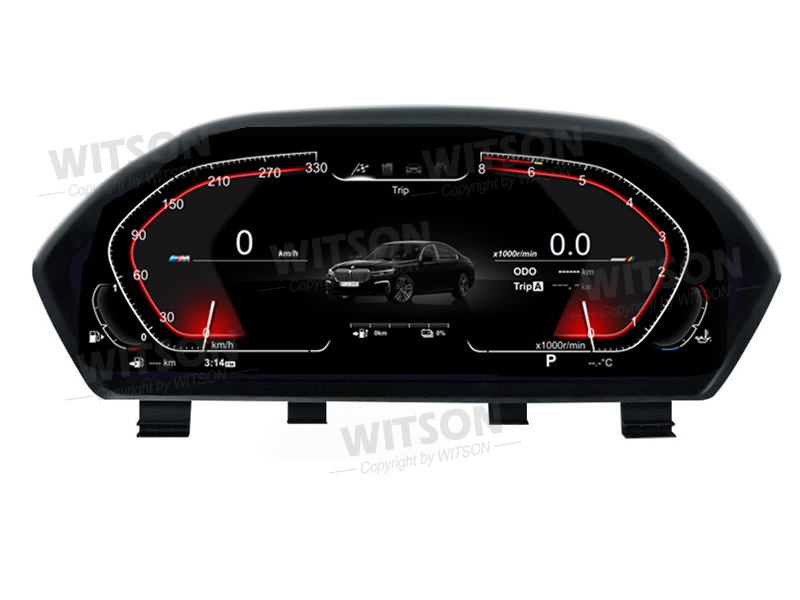
Trust me, the drivetrain is not the problem. The dashboard is the problem. And it is also, conveniently, the one part of the car you can replace in about an hour. The fix is the 12.3" Digital Speedometer Instrument Cluster (YB1292) - a proper widescreen replacement for the 3 Series F30, F31, F34 and 4 Series F32, F33, F36 that reads your car's own data and displays it the way a 2026 car would.
TL;DR
The analogue cluster is the last dated component in an otherwise modern BMW, and it sits directly in your eyeline every single drive. The Witson YB1292 replaces it with a 12.3-inch wide-format panel at 1920 x 720, driven by a dedicated T507 quad-core processor at 1.5 GHz running a real-time Linux system, with four selectable layouts and instant switching between them. It reads your car's original protocol directly - so tyre pressures, oil and water temperature, oil pressure, fuel consumption and body balance data all come through, alongside speed, RPM and fuel. Installation is plug-and-play with the original connectors, with no coding and no wire cutting, and it is fully reversible back to the factory cluster. One important caveat before you buy: this variant cannot be fitted to cars with the factory head-up display - check that first, because no seller can code around it.
The Problem: Two Dial Faces and a Calculator
The F30 cluster was a perfectly reasonable instrument in 2012. It is a frustrating one now. Speed and revs are beautifully done; everything else is buried. Want your oil temperature? Menu. Instant fuel consumption? Deeper menu. Tyre pressures? Not on the cluster at all - over to the centre screen, which means taking your eyes off the road to read something that should have been thirty centimetres in front of you.
And it decays. Dial faces dull, needles get slow, and the centre strip starts to look like something pulled out of a 2005 cash register. Every newer BMW you park beside has a fully digital dash with a configurable layout. Yours has a physical dial you cannot change, cannot restyle, and cannot make show you anything more useful than a number.
Agitation: What a Cheap Cluster Actually Does to You
Here is the deal, and it is the same trap as every other category in car electronics. Search for a 12.3" BMW cluster and you will find listings at half the price with photos that look identical. What is inside is a generic board, an unnamed processor, and a Linux image that was never properly integrated with BMW's protocol stack.
The symptoms show up fast. Needle lag - the tacho trails the engine by half a second, which is genuinely unsettling when you are driving a car with a manual or a DCT. Missing warnings - half the indicator lamps and status messages simply never light up, because the unit is guessing rather than reading. Boot behaviour - three or four seconds every start, and on a cold morning an occasional mid-drive reboot, which is the sort of thing that turns a motorway journey into a phone call to a recovery service. Then the thermal problem: a dashboard in summer sun is a hostile environment, cheap panels ghost and delaminate, and by the following year you are pulling the thing back out.
That is not a dashboard upgrade. That is a piece of electronics living forty centimetres from your face that you do not trust.
Core Features: What the YB1292 Actually Does
1. Full Original Data, Read Directly From the Car
This is the dividing line between a cluster that works and one that annoys you daily. The YB1292 reads your BMW's original protocol over CAN-BUS instead of estimating values. That means tyre pressure information, oil and water temperature, oil pressure, fuel consumption, body balance data, trip computer and odometer readings all come through accurately, in addition to speed, tachometer and fuel level. Your indicator lamps and status messages behave as they did before, because nothing is being invented.
2. Your Audio System Is Untouched - The Cluster Is Not in the Audio Path
Worth saying plainly, because it comes up constantly: this unit has no audio path of its own. It does not intercept your amplifier, it does not drive your speakers, and it does not touch the factory head unit. Whatever audio setup you already have - standard, HiFi, Harman Kardon, or an aftermarket amp and sub - keeps working exactly as it does today. Nothing to re-tune, nothing to re-wire, no DSP settings to rebuild from scratch.
3. Original Steering Wheel Controls and Cluster Menus Stay Working
Your existing steering wheel buttons keep doing what they did, and cluster settings are reached the same way as before - through the controls already in the car. There is no additional adapter module to buy, and no relearning. That sounds like a small thing until you have driven a car where the volume button no longer does anything.
4. Dedicated Quad-Core Hardware on a Real-Time Linux System
You will see clusters advertised with eight cores and big RAM numbers. For this job, that is marketing, not engineering. A dashboard is a deterministic, real-time task - it must refresh the needle smoothly and never miss a frame, and it does not need to run five apps at once. The YB1292 uses a T507 quad-core processor at 1.5 GHz with 1GB RAM, running a Linux-based real-time system. Real-time prioritisation is what gives you a needle that tracks your right foot precisely instead of lagging behind it. Focused hardware beats a big number on a spec sheet here, every time.
5. 12.3" Wide Format at 1920 x 720
The screen is a 12.3-inch wide-format panel at 1920 x 720. A word on the marketing you will read everywhere: some listings call these panels QLED, others IPS. Both are used across different production batches, and the honest position is that what actually matters is the resolution (1920 x 720), the viewing angle, and whether the finish is anti-glare - a glossy dashboard panel becomes a mirror the moment the sun drops behind you. Ask about the finish, not the acronym.
6. Four Layouts and Multiple Light Colours
You can choose between four dashboard layouts - commonly Classic, Sport, Comfort and Technology - and switch them without waiting. There are also selectable button and accent light colours, so the cluster can be matched to the ambient lighting you already have. It is a small customisation, but it is the difference between a dash that looks bolted on and one that looks specified.
7. Plug and Play, No Coding, Fully Reversible
The housing is 3D-scanned from the original dashboard and moulded to match, and the unit connects through the original connectors with no cutting and no modifications. There is no laptop, no coding session, and no programming step. Your factory cluster goes in a box in the garage, and it goes back in whenever you want - which also keeps the modification genuinely reversible if the car is ever sold or inspected.
Which BMW Does This Fit? Check Your Chassis Code First

| Model | Chassis codes | Years | System and notes |
|---|---|---|---|
| 3 Series | F30, F31 | 2013 - 2019 | NBT - factory HUD not supported |
| 3 Series GT | F34 | 2013 - 2019 | NBT - factory HUD not supported |
| 3 Series Li | F35 | 2013 - 2019 | NBT - factory HUD not supported |
| 4 Series Coupe | F32 | 2013 - 2020 | NBT - factory HUD not supported |
| 4 Series Convertible | F33 | 2013 - 2020 | NBT - factory HUD not supported |
| 4 Series Gran Coupe | F36 | 2013 - 2020 | NBT - factory HUD not supported |
Read this before you order: this cluster cannot be fitted to a car with the factory head-up display. The HUD projector and its aperture in the dash are the blocker - it is a physical and electrical incompatibility, not a coding problem, so no seller can work around it. If your F30 or F32 was specified with the HUD, this is not the product for you. Check your build sheet first. If you are unsure, send the seller your VIN and let them confirm in writing.
Two more things worth confirming up front. The unit is designed around the NBT system, which covers the vast majority of 2013-2020 F30 and F32 builds - but if your car is an early production model running CIC, confirm compatibility with the seller before paying. And if you drive an M3 F80 or M4 F82 / F83, owners do fit these clusters, but those are not listed in the standard fitment table, so get explicit confirmation rather than assuming.
Standard vs High-Performance: What the Extra Money Buys
The listings look the same. The hardware does not. Here is where the money actually goes.
| Specification | Standard / Budget Build | High-Performance Build (Witson YB1292) |
|---|---|---|
| Operating system | Generic Linux image, not integrated with BMW protocol | Linux-based real-time system, anti-crash |
| Processor | Unnamed chip, throttles under load | Dedicated T507 quad-core at 1.5 GHz |
| Memory | 1GB RAM, unverified firmware build | 1GB RAM, firmware verified against the car's protocol |
| Panel | Glossy, un-laminated panel | Anti-glare finish, 12.3-inch, 1920 x 720 |
| Needle and animation response | Visible lag, dropped frames | Smooth, real-time prioritised graphics path |
| Original protocol coverage | Partial - some indicator lamps and status messages missing | Full - tyre pressure, oil and water temperature, oil pressure, fuel consumption, body balance data |
| Boot behaviour | 3 - 4 seconds, occasional mid-drive reboot | Fast start, stable under load and heat |
| Dashboard layouts | One fixed layout | Four layouts plus selectable accent light colours |
| Housing and fitment | Generic moulding, gaps around the trim | 3D-scanned from the original dash, matches the aperture |
| Coding or programming | Often required | None - plug and play, original connectors |
| Reversible to the stock cluster | Varies, sometimes not | Yes - original connectors and mounting points |
| Warranty | 6 - 12 months, seller-dependent | Up to 24 months - confirm with the seller |
Installation and Compatibility: What Actually Happens on the Day
The YB1292 uses the original wiring connectors and original mounting points, and the housing is moulded from a 3D scan of the factory dashboard, so it drops into the aperture the way the original did. No cutting, no splicing, no coding, nothing to program afterwards. Budget about an hour. A local installer will charge for one hour of labour and it is money well spent if you have never had dashboard trim apart.
What stays working after the swap
Indicator lamps, warning messages and status displays, read from the car's original protocol
Tyre pressure information, oil and water temperature and oil pressure readings
Fuel consumption, body balance, trip computer and odometer data
Your entire existing audio system, untouched - the cluster is not in the audio path
Original steering wheel controls and the existing cluster menu controls
Factory diagnostics: nothing needs reprogramming, and the original cluster can be refitted

Before you start
You will need plastic trim removal tools and a Torx driver set. Disconnect the battery negative terminal first. The instrument surround and lower dash trim come away before the cluster itself, and the clips on a ten-year-old BMW dash are not forgiving - work slowly, in warm conditions if you can, and keep the removed trim somewhere safe rather than on the floor. Lay the original cluster on something padded. And do the VIN check for the head-up display before you order, not after the box arrives.
Buying Checklist: Eight Checks Before You Pay
Ten minutes here saves a summer of regret. Run all eight.
Confirm your car does not have the factory head-up display. If it does, this cluster will not fit. This is the single most important check on this page - get it confirmed in writing against your VIN.
Send the seller your chassis code, model year and factory system. F30 is not one specification; NBT versus CIC matters, and the wrong harness variant is the most common cause of a failed install.
Ask for real footage of the cluster running in your exact model. Not a render, not a stock image - the actual car, actually moving.
Confirm which original data channels are supported. Tyre pressure, oil pressure, oil and water temperature, fuel consumption and body balance data are the ones that separate a full protocol implementation from a partial one.
Confirm the panel finish and resolution. Insist on 1920 x 720 and ask whether the finish is anti-glare. "12.3 inch HD" on its own means nothing.
Verify it is reversible. Original connectors or walk away. Any product that requires cutting wires is not a cluster upgrade, it is a commitment.
Read reviews for needle lag, rebooting and missing warning lamps. Those three complaints tell you more than any star average.
Check the warranty and who honours it. A manufacturer with its own factory and a documented burn-in test before shipping is a completely different proposition from an anonymous storefront with a short return window.
The unit in this article: a 12.3" 1920 x 720 digital instrument cluster with a real-time Linux system, a dedicated T507 quad-core processor, four selectable dashboard layouts, full original protocol data retention including tyre pressure, oil pressure and temperature readings, and true plug-and-play fitment with no coding - for BMW 3 Series F30, F31, F34 and F35, and 4 Series F32, F33 and F36 from 2013 to 2020. Not suitable for cars with the factory head-up display.
FAQ
Will CarPlay or Android Auto show up on this digital cluster?
No - and that is by design. This is an instrument cluster, not a multimedia head unit. It displays your car's own data: speed, RPM, fuel, temperature, tyre pressures, oil pressure, fuel consumption and trip information. Media content such as playlists, Bluetooth tracks and radio stations does not render here, and neither does a CarPlay or Android Auto interface. Your CarPlay keeps living where it already lives - on the factory iDrive screen or your aftermarket head unit, and this cluster does not interfere with it in any way, because it is not in the audio or media path. If what you want is CarPlay in an F30, you want a head unit replacement; if you want the dashboard to look and read like a modern BMW, this is the part you buy. Plenty of owners do both, and they work together without conflict.
My car has the factory head-up display - can I still fit this cluster?
No, and this is not negotiable. The YB1292 cannot be fitted to cars with the factory head-up display. The HUD projector sits in the same aperture and its wiring is part of the same loom, so this is a physical and electrical incompatibility rather than something a coding session can solve. Check your build sheet or send the seller your VIN before ordering. If you do have the HUD, ask about alternatives rather than ordering and hoping - this is the most common way people end up returning a cluster.
Do I need coding or programming, and can I put the original cluster back?
No coding, no programming, no laptop, no coding session at an independent specialist. The cluster reads your car's original protocol directly through the supplied harness, and it connects using the original connectors and original mounting points. That makes the whole thing reversible: keep the factory cluster boxed in the garage, and it goes back in whenever you want - which matters if you ever sell the car or need it returned to standard. Installation is roughly an hour of trim work.
Will my warning lamps, tyre pressure readings and steering wheel controls still work?
Yes. Because the cluster reads the car's original protocol rather than estimating values, indicator lamps, warning messages, tyre pressure information, oil and water temperature, oil pressure, fuel consumption and body balance data all come through accurately - and this is precisely where cheap clusters fail, which is the whole reason to buy a properly integrated unit. Cluster settings are reached through the controls already in your car, with no extra adapter module to buy, and your existing audio system is completely untouched because the cluster has no audio path of its own.
Will it fit my M3 F80 or M4 F82 / F83, or an early F30 running CIC?
Both cases need confirmation from the seller before you buy. The standard fitment covers 3 Series F30, F31, F34 and F35, and 4 Series F32, F33 and F36, designed around the NBT system - which covers the large majority of 2013-2020 production. Early F30 builds running CIC, and the M3 F80 and M4 F82 / F83, sit outside that standard listing. Owners do fit these clusters to the M cars, but rather than assume, send the seller your chassis code, model year and VIN and get an explicit yes. A seller who cannot answer that question is a seller you should not be buying from.
Final Word
As my experience with the F-series goes, the 3 and 4 Series still drive better than most of what replaced them. What they lack in 2026 is a dashboard that looks like it was designed after the smartphone existed - and of everything in the cabin, that is the one thing you look at constantly and the one thing you can actually change.
Do not paper over it with a phone mount. Fix the surface your eyes rest on. Get the 12.3-inch panel, a real-time Linux system with focused hardware, full original data retention, no coding, and a harness that lets you put it all back - and your 2014 F30 will feel current every single time you turn the key.