BMW 5 Series E60 E61 · 6 Series E63 E64 · 2003-2009 · Witson YB1293
Your E60 Still Drives Like a BMW. Its Dashboard Looks Like an Old Fax Machine. Here Is the 12.3" Fix.
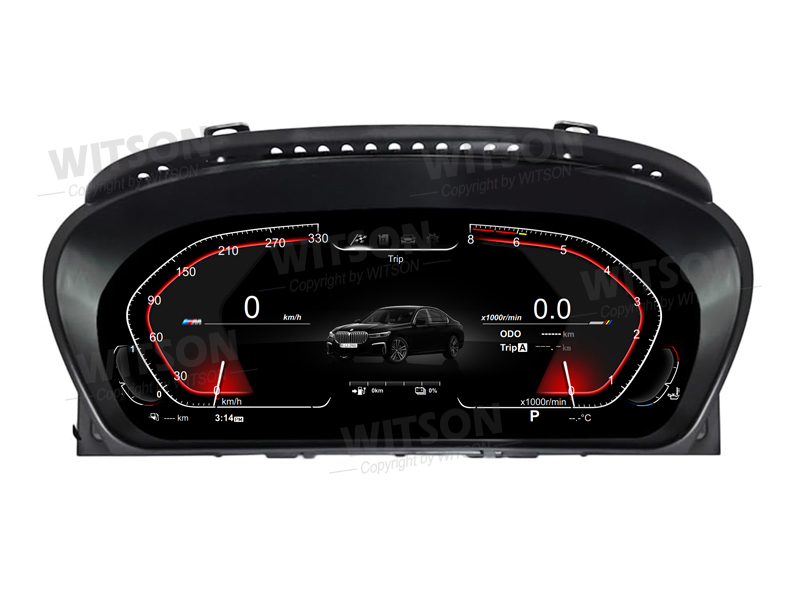
The Witson YB1293 is a 12.3" IPS 1920 x 720 digital instrument cluster that drops straight into the BMW 5 Series E60/E61 and 6 Series E63/E64 (2003-2009) dashboard opening and replaces the tired analog dials with a full digital cockpit. It runs Linux with a T507 quad-core processor, boots in under 3 seconds, keeps your original mileage and every factory warning light, needs zero coding, and this particular chassis even adds wireless CarPlay and Android Auto through a built-in CarPlay chip on the upgraded motherboard. Plug and play, no wire cutting.
The Problem: Great Chassis, 2004 Dashboard
Listen, I have said this to E60 owners a hundred times. You bought the car for the chassis. The steering feel, the straight-six, that long-wheelbase ride on the motorway. Then you sit down and you are staring at four analog dials designed in the era of flip phones, a dot-matrix information strip with the resolution of a supermarket receipt, and orange backlighting that has aged about as well as a 2004 ringtone.
The car itself is fine. The dashboard is the thing that makes it feel old. Every passenger who gets in notices the same thing, and no amount of detailing changes it. A modern phone mount, a new head unit, none of it fixes the one screen you actually look at while driving.
The Agitation: Cheap Cluster Upgrades Are a Trap
Here is the deal, and this is where people get burned. You go online, you see a 12.3" cluster for a couple of hundred dollars, you order it, and six months later you are writing a one-star review.
What goes wrong is always the same list. The cheap boards run a full Android stack with 8 cores that nobody needs for a gauge display, so cold start takes 8 to 12 seconds - roughly a third of your commute with a black screen where your speed should be. Cheap units lose original mileage, so your odometer now disagrees with your service history. Warning lights go missing, which matters more than people realise: if a brake wear or coolant warning never renders, you find out about the fault at the workshop, not on the dash. And the panels are glossy, uncoated, and unshielded, so in August sun you get glare plus a screen that has permanently bloomed from heat soak.
Trust me on this one. A cluster is not a phone. It is the one component in the car you are legally required to be able to read, in direct sunlight, at speed.
The Solution: A Cluster Built for the Job
This is where the YB1293 earns its place. It is not a phone screen stuffed into a cluster housing. It is a Linux-based instrument designed around one job: showing vehicle data instantly and never lying to you.
Factory Function Retention Comes First
Before we talk about anything pretty, understand what stays. The YB1293 uses a dual-chip architecture: one processor handles the display, a separate path handles the original vehicle bus. Your original mileage is retained and displayed, door open and close reminders work, fuel level and fuel consumption render, tire pressure information comes through, and the factory warning and indicator set is preserved. No coding and no programming are required for basic functionality.
As my experience goes, this is the single question you should ask any seller before you pay: does the cluster keep the original car data, or does it just show a pretty speed readout? Plenty of listings only do the second one.
Steering Wheel Controls and Factory Integration
The cluster works with your original steering wheel controls. You are not adding an aftermarket button pad or a dangling remote. The factory harness plugs into the original car line, so the buttons you already reach for keep doing what they always did. There is no separate amplifier and no DSP inside this product either, which is a good thing: it never takes over your audio path, so your factory amplifier, speakers and any aftermarket DSP stay exactly as they are. Nothing to re-tune, nothing to re-wire.
One honest note: the display is not a touchscreen. That is deliberate. A touch layer adds a glossy stack, a failure point and a fingerprint magnet in your line of sight. You drive this cluster from the steering wheel and the factory controls, the way it should be.
Wireless CarPlay and Android Auto - Yes, Really, on This One
Now the part that surprises people. The upgraded motherboard used in this E60/E63 family has a built-in CarPlay chip, so the cluster supports wireless CarPlay and Android Auto, plus Android screen mirroring. Navigation, calls and media can surface on the cluster in front of you instead of on a phone suction-cupped to the windscreen.
I want to be precise here, because specs differ between SKUs and I am not going to blur them. On the F-series clusters (the F10/F07 and F30/F32 units), CarPlay is not supported - those are pure instrument displays. On this E60/E61/E63/E64 cluster, the CarPlay board is a real option. Audio routing for CarPlay depends on your factory audio configuration, so confirm with the seller how it routes (AUX or factory Bluetooth) before you order.
The Display: 12.3" IPS, 1920 x 720, Anti-Glare
You get a 12.3" IPS panel at 1920 x 720, ultra-wide, with a blue-light-reduced anti-glare coating. IPS means the parallel transistor layout keeps blacks deep and viewing angles wide, so the cluster stays legible from the passenger seat and in low-light tunnels. The anti-glare layer is the part that matters in real life: it is the difference between readable and a mirror at noon, and it is usually the first thing cut from a cheap unit.
About the "8-Core" Question
You will see cheap clusters bragging about eight cores. Here is the honest engineering answer. A gauge refresh is a deterministic real-time task, not a multitasking workload. It does not want eight cores competing for scheduling; it wants a real-time kernel with a fixed priority so the needle lands where the bus said it should, immediately.
The YB1293 runs a T507 quad-core at 1.5 GHz with 1 GB of RAM on a Linux real-time system, and that combination is why it goes from ignition to a live instrument display in under 3 seconds - well under the 8 to 12 seconds a bloated Android board takes. Fewer cores, faster to a useful screen. That is the trade, and for a cluster it is the right one.
Themes, Units and Languages
Four layouts ship with the unit - Simple, Comfortable, Technology and Sport - and you can adjust colour to match the interior. When you feel like a restrained classic dial set, you use Simple. When you want a technical cockpit, you switch. Your car does not have one driving mood, so your dashboard should not either.
Units are switchable, including MPH, miles and MPG for UK owners. Language coverage runs to 13 options, including English, German, French, Italian, Spanish, Russian, Japanese, Korean, Turkish and Arabic. There is also proper diesel and petrol support - the factory setting is 6000 RPM for diesel and 8000 RPM for petrol, so a 530d and a 545i both read correctly.
Will It Fit My Car? BMW E60 / E61 / E63 / E64 Fitment
| BMW Model | Chassis | Years Covered | Notes |
|---|---|---|---|
| 5 Series Sedan / Touring | E60 / E61 | 2003-2009 | CCC on earlier builds, CIC on later ones - specify which |
| 6 Series Coupe | E63 | 2003-2009 | Same harness family as E60 |
| 6 Series Convertible | E64 | 2003-2009 | Same harness family as E60 |
| Left-hand drive | All above | All above | Confirm LHD when ordering |
| Right-hand drive | All above | All above | Confirm RHD when ordering - fitment differs |
| Diesel engines | All above | All above | 6000 RPM scale supported |
| Petrol engines | All above | All above | 8000 RPM scale supported |
Check this before you pay: cars fitted with the factory Head-Up Display (option 610) are not supported on this fitment.
On a HUD-equipped car, the display projector and its associated wiring sit in the same area and share the same information path as the cluster. That is a physical and electrical conflict, not something a coding session can resolve. If your E60 or E63 has the factory head-up display, or has had one retrofitted, do not order this cluster until the seller has confirmed the fitment against your VIN and dashboard photos. Also flag any previous dashboard or electrical modification - rewired clusters from earlier repairs are a common source of fitment surprises.
Standard vs High-Performance: What You Are Actually Choosing
| Specification | Standard | High-Performance |
|---|---|---|
| Motherboard | Base board | Upgraded board with CarPlay chip |
| Display | 12.3" IPS, 1920 x 720 | 12.3" IPS, 1920 x 720, anti-glare |
| Operating system | Linux real-time | Linux real-time |
| Processor | T507 quad-core 1.5 GHz | T507 quad-core 1.5 GHz |
| Memory | 1 GB RAM / 4 GB flash | 1 GB RAM / 4 GB flash |
| Wireless CarPlay | Not available | Supported |
| Android Auto / mirroring | Not available | Supported |
| Startup time | Under 3 seconds | Under 3 seconds |
| Original mileage retained | Yes | Yes |
| Coding required | None | None |
| Themes | Simple, Comfortable, Technology, Sport | Simple, Comfortable, Technology, Sport plus colour options |
| Software updates | Standard support | Updated firmware and ongoing support |
| Warranty | 12 months | 12 months |
Installation and Compatibility
This is a plug-and-play replacement, and I mean that in the literal sense: the new cluster connects to the original car line, so there is no wire cutting, no soldering and no coding. The harness is vehicle-specific and the connectors are OEM-style.
The general sequence is: disconnect the battery, unclip the two retaining buckles on the factory cluster with the supplied pry tool, pull the old unit out, connect the new cluster to the original car line, seat it in the opening until the clips engage, then reconnect the battery. Budget an afternoon if you are doing it yourself the first time; the trim is the only part that demands patience, not skill.
What stays working after the swap:
Original mileage and odometer reading
Factory warning lights and indicator symbols
Fuel level and fuel consumption display
Door open and close reminders
Tire pressure information
Steering wheel controls
Factory amplifier and speaker system, untouched
Diesel or petrol RPM scaling, according to your engine
Electrical specs, for the people who ask: 9-16 V working voltage, 0.8-1.5 A working current, under 3 mA standby. It behaves like a factory module on the bus, which is exactly what you want. Unit weight is around 3.5 kg. The package includes the cluster, the plug-and-play wiring harness and installation accessories.


Buying Checklist: 8 Things to Confirm Before You Pay
1. Get the exact RAM and flash size in writing. "Linux" alone is not a spec. Ask for the T507 processor, RAM and flash numbers in the chat log, not just on the listing page.
2. Confirm CCC or CIC against your own car. Check your iDrive menu and the LVDS plug, or send the seller a photo of your radio menu. Getting this wrong is the number one return reason on E60 clusters.
3. Send a photo of your original cluster. Fitment on this chassis is vehicle-specific. If the seller will not ask for a photo, they are guessing.
4. Ask for a real photo of the harness. A warehouse stock image is not evidence. You want to see the actual connectors that will plug into your car.
5. Confirm head-up display status. If your car has factory option 610, stop and get written confirmation before ordering.
6. State your market, driving side and units. LHD or RHD, and MPH or km/h - tell them up front so it ships configured correctly.
7. Get the warranty and who honours it in writing. 12 months is standard here, but ask whether claims are handled by the seller or bounced back to the factory.
8. Read the heat and DOA reviews, not the star average. Search the reviews for "restart", "hot", "flicker" and "dead on arrival". Those words tell you more than a 4.6 rating ever will.
Ready to Bring the E60 Cockpit Into This Decade?
The Witson 12.3" digital instrument cluster for BMW 5 Series E60 E61 and 6 Series E63 E64 with wireless CarPlay, original mileage retention and no coding is the version built for this chassis specifically - Linux real-time board, T507 quad-core, under 3 second startup, anti-glare 1920 x 720 IPS panel. Send the seller your chassis code, build year, CCC or CIC status and a photo of your current cluster, and they will match the correct harness to your car.
FAQ
Will Android Auto and Apple CarPlay actually work on this cluster, or do I need a separate head unit?
On this E60/E61/E63/E64 cluster they work directly. The upgraded motherboard has a built-in CarPlay chip supporting wireless CarPlay and Android Auto, plus Android screen mirroring, so navigation and calls can show on the cluster itself rather than on a phone mount. Two caveats worth knowing. First, the Standard configuration does not include the CarPlay board, so confirm which version you are buying. Second, audio routing depends on your factory audio setup, so ask the seller whether CarPlay audio goes out over AUX or your factory Bluetooth before you order.
Do I need coding, and will I lose my original mileage?
No coding, and no, you will not lose your mileage. The cluster uses a dual-chip architecture where the original vehicle bus is handled separately from the display path, so your original mileage continues to be displayed and the factory warning set is preserved. There is no programming step and no wire cutting. This is also the single most important thing to verify with your seller - plenty of cheap clusters show an accurate speed and nothing else, and an odometer that disagrees with your service history is a real problem at resale.
My E60 has the factory head-up display. Will this cluster still fit?
This is the one you need to check before paying. Cars fitted with the factory Head-Up Display (option 610) are not supported on this fitment. The projector and its wiring share the same area and information path as the cluster, so it is a physical and electrical conflict rather than a software setting. If your car has a factory HUD or a retrofitted one, give the seller your VIN and dashboard photos and get written confirmation before ordering. Be aware that this answer is chassis-specific: the 5/6/7 Series F10 cluster does retain HUD on most variants, while the F30/F32 unit does not support it either. Never carry one cluster's fitment answer over to another.
Is it a touchscreen, and does it keep my steering wheel buttons and parking sensors?
It is deliberately not a touchscreen. A touch layer adds glare, fingerprints and an extra failure point directly in your eyeline. You operate the cluster with the original steering wheel controls, which continue to work as before, and the factory information path is retained, so door reminders, fuel data, tire pressure information and the indicator set all keep functioning. Because the cluster never takes over the audio path, your factory amplifier, speakers and parking system stay exactly as they were - nothing needs re-tuning or re-wiring.
Why does it only have a quad-core processor when cheaper clusters advertise eight cores?
Because a gauge display is a real-time task, not a multitasking one. What matters is that the display updates at a fixed priority on a deterministic kernel, not that eight cores compete for scheduling. The T507 quad-core at 1.5 GHz running Linux gets you from ignition to a live instrument display in under 3 seconds, while heavier Android boards of the same price typically take 8 to 12 seconds - which is a long time to drive with a blank cluster. Fewer, better-directed cores is the correct engineering choice here.
Final Word
Your E60 or E63 was a properly engineered car and it still drives like one. The dashboard is the last thing letting it down, and it is the one thing a passenger sees before anything else. Swapping analog dials for a 12.3" digital cluster is one of the highest-return interior upgrades you can do on this chassis, and because it is plug and play with no coding, the risk sits much lower than the price difference suggests.
Just do the two checks first: confirm CCC or CIC, and confirm you do not have the factory head-up display. Sort those out and it is a straightforward afternoon job that changes the car every single time you get in.
Fitment note: Designed for BMW 5 Series E60 / E61 and 6 Series E63 / E64, model years 2003-2009, in both CCC and CIC configurations, with diesel and petrol RPM scaling supported. Left-hand drive and right-hand drive versions are ordered separately - state your driving side and target market when ordering.
Vehicles fitted with the factory head-up display (option 610) are not supported on this fitment. Fitment on this chassis is vehicle-specific: exact year ranges, CCC/CIC split and harness type vary by market, build date and factory options. Configurations and specifications may change between production batches. Always confirm your chassis code, build year, system type and original cluster with the seller before purchase, and have the unit installed by a qualified technician.